Showing posts with label Holy Week 2011. Show all posts

Saturday, April 23, 2011

Holy Week Special: Easter Sunday

Easter morning is marked with joyous celebration, the first being the dawn ceremony called the Salubong (Filipino: "meeting"). Images of the Resurrected Christ and the Virgin Mary, are brought in procession together to meet at a designated area called a "Galilea", usually located at the plaza fronting the church. It plays out the imagined reunion of Jesus and his mother Mary after the Resurrection. In some locales, statues of other saints involved in the Resurrection narrative accompany them, such as St. Peter and Mary Magdalene, as well as St. John the Evangelist.

The Virgin Mary is clothed or at least veiled in black to express bereavement. A girl dressed as an angel, positioned on a specially constructed high platform/scaffold or suspended in mid-air, sings the Regina Coeli in Latin or a local language and then dramatically removes the black veil, signifying the end of her grieving. This is accomplished by the "angel" simply pulling off the veil, or by tying it to balloons or doves and releasing these into the air. The Virgin is then transformed into the Nuestra SeƱora de Alegria, or Our Lady of Joy. The moment is marked by pealing bells and fireworks, followed by the Easter Mass that begins right after sunrise either at 6 or 7 in the morning. In some parishes however the pratice is done on midnight of Easter Sunday after the Easter Virgil the night before.

Easter Gospel:

Sunday, April 24, 2011 
Easter Sunday (Solemnity)
First Reading:
Psalm:
Second Reading:
Gospel:


Can the life of a good Christian be anything other than that of a man nailed to the Cross with Jesus Christ?
-- St. John Vianney


love, now and always, 

Friday, April 22, 2011

Holy Week Special: Black Saturday


Black Saturday or Sabado de Gloria has the traditional silence and solemnity from the previous day spill over. Preparations are made for the Easter Vigil to be celebrated that evening.

Some parishes have a presentation where Judas hangs himself because of his treachery towards Jesus.


Black Saturday Gospel:
Saturday, April 23, 2011 
Holy Saturday Night: The Easter Vigil


Psalm 42:3, 5; Psalm 43:3-4 (Read when baptism is celebrated) 
(Ps) Isaiah 12:2-6 or Psalm 51:12-15, 18-19 (Read when baptism is not celebrated)

8) Epistle: Romans 6:3-11

9) Gospel: Mark 16:1-7

We confess that one and the same Christ, Lord, and only-begotten Son, is to be acknowledged in two natures without confusion, change, division or separation. The distinction between the natures was never abolished by their union, but rather the character proper to each of the two natures was preserved as they came together in one person (prosopon) and one hypostasis.
-- Council of Chalcedon


love, now and always, 

Thursday, April 21, 2011

Holy Week Special: Good Friday

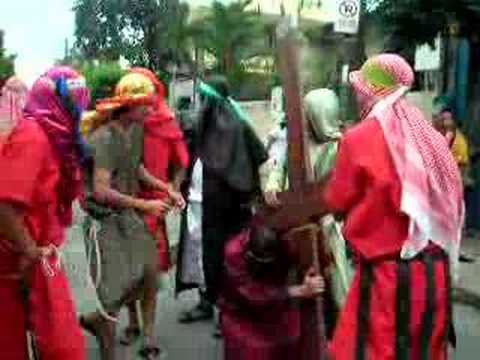
Good Friday, or Biyernes Santo, is a public holiday, commemorated with solemn street processions, the Way of the Cross, the commemoration of Jesus' Seven Last Words or Siete Palabras, and a traditional Passion play called the SenĆ”kulo. 


In some communities, the processions include devotees who self-flagellate and sometimes even have themselves nailed to crosses as expressions of penance, in fulfillment of a vow, or in thanksgiving for a granted request.


After three o'clock in the afternoon (the time Jesus is traditionally believed to have died), all noise and merrymaking is discouraged, bathing is proscribed, and the faithful are urged to keep a solemn and prayerful disposition. Siete Palabras services, both on television and in parish churches, conclude at this moment. The Mass of the Passion of the Lord is held in all parish churches with the veneration of the cross for the closing.

Towards evening, there is a funeral procession of the deceased Christ known as "Prusisyon ng Sto. Entierro", similar to the procession of the epitaphios in Eastern Orthodoxy. The statue of the dead Christ, known as the Santo Entierro, is borne on a decorated "Calandra", funeral carriage , after which it brought around the community and back to the church to be venerated by the faithful and the "Pahalik sa SeƱor". Such a procession may involve images of other saints, but regardless of the number, tradition dictates that the last image in the procession is always the Mater Dolorosa. Other images in groups participating are those depicting the decent from the cross or burial.


Some places accord the statue of the Santo Entierro with proper funeral rites, such as laying the body in state or, as in some instances, by smoking the image over a fire in accordance with local, pre-Hispanic funerary customs. In the town of Pakil, Laguna,a tradition wherein the Santo Entierro is smoked several times along the procession, using lansones peelings for the fire while someone shouts "¡SeƱor, Misericordia, SeƱor!".


The marathon chanting or "pabasa" of the Pasyon, the epic narrative of Christ's Life, Passion, Death, and Resurrection, usually concludes on this day.

Good Friday Gospel:
Friday, April 22, 2011 
Good Friday
First Reading:
Psalm:
Second Reading:
Gospel:
Unless you strive after virtues and practice them, you will never grow to be more than dwarfs.
-- St. Theresa of Avila


love, now and always, 

Wednesday, April 20, 2011

Holy Week Special: Maundy Thursday

Maundy Thursday (Huwebes Santo) is the beginning of the Triduum (3 days leading up to Easter Sunday).

In the morning, the faithfuls (especially those living near the cathedral) join their parish priest in the usual morning mass in the cathedral. This time of the day is a very joyful celebration as this is considered by many priests in the country to be the day when they renew their sacerdotal vows. In most cases, banners saying 'WE LOVE YOU FATHER (name of the priest)' is seen outside the cathedral (or somewhere else appropriate) to signify their support their parish priests.


Also celebrated on this day is the last Mass before Easter (commonly called the Mass of the Institution of the Lord's Supper) usually including a reenactment of the Washing of the Feet of the Apostles; this Mass is followed by the procession of the Blessed Sacrament before it is taken to the Altar of Repose. A popular tradition is "Church Visit" or "Visita Iglesia", which usually involves going to 7 different churches to visit the exposed blessed sacrament after it is placed in the Altar of Repose.


Q: Why do people visit seven churches on Holy Thursday?

A: The custom goes back to the early Church when Christians would visit the seven great basilicas in Rome for adoration of the Blessed Sacrament after the Mass of the Lord's Supper on Holy Thursday. The sacramentary, the official altar book of the Church, says that after this Mass, "The faithful should be encouraged to continue adoration before the blessed sacrament for a suitable period of time during the night, according to local circumstances, but there should be no solemn adoration after midnight."

Visita Iglesia is a practice in cities, where there are many churches, in countries as diverse as Malta, Poland, Ireland and The Philippines. Filipinos have brought it to places in North America that never had it before.
Source: The Catholic Herald

Visita Iglesia can also be done online, click HERE. 


Maundy Thursday Gospel:

The Easter Triduum
Thursday, April 21, 2011 
Holy Thursday Evening – Mass of the Lord's Supper
First Reading:
Psalm:
Second Reading:
Gospel:
After you have made a decision that is pleasing to God, the Devil may try to make you have second thoughts. Intensify your prayer time, meditation, and good deeds. For if Satan's temptations merely cause you to increase your efforts to grow in holiness, he'll have an incentive to leave you alone.
-- St. Ignatius of Loyola


love, now and always, 

Monday, April 18, 2011

Visita Iglesia Online


Catholics do not have to visit churches during the traditional “Visita Iglesia.’’ They can also do it online. By clicking the Catholic Bishops’ Conference of the Philippines (CBCP) Visita Iglesia website, visitaiglesia.net,  the faithful would be able to visit seven famous churches in the country.

These are the Manila Cathedral Basilica and San Agustin Church in Intramuros, Manila; Minor Basilica of the Black Nazarene in Quiapo, Manila; San Lorenzo Ruiz Church and Santo NiƱo de Tondo Parish in Tondo, Manila; Nuestra Senora de Remedios in Malate, Manila; and Our Lady of Perpetual Help Shrine in Paranaque.

Aside from putting the picture of the church, the CBCP also included the 14 Stations of the Cross with the corresponding prayer. “This is to make the Visita Iglesia experience of the faithful complete,’’ the CBCP said.


But CBCP Media Director Msgr. Pedro Quitorio stressed that the portal should only serve as a substitute, especially those who cannot really go to church for some valid reasons.


source: Manila Bulletin

love, now and always, 

Sunday, April 17, 2011

Holy Week Special: Holy Monday to Holy Wednesday

Holy Monday to Holy Wednesday indicates the start of the singing of the Pasyon or Pabasa. The Pasyon signifies the vernacular verse on the life and sufferings of Jesus Christ, which continues day and night, for two successive days. The chanting tradition of the Pasyon is a solemn pledge made by the family or an individual where the reading was made.

It is a tradition that remained well preserved particularly in the provinces, where it is held continuously day and night sometimes for as long as three straight days.


During Holy Wednesday, some men carry out the Penitensiya, which is common during holy week. It is an act of self-punishing penitent, where somebody who whips himself as a form of penance. It is usually the reenactment of the sufferings of Jesus by carrying the wooden cross. These actions are carried out until Good Friday.

In the Philippines…


Beginning Holy Wednesday, businesses in the Philippines either shut down operations until Black Saturday or have later opening and earlier closing times, while mostly local television or radio stations suspend programming or continue broadcasting with more solemn or religious content. An example is the airing of the Seven Last Words on Good Friday live from churches on various local channels and films about the life and death of Jesus. During the Easter Triduum, usually a public holiday, some television stations even interrupt broadcast altogether until Black Saturday in observance of this solemn occasion. In the Ilocos region, a common practice is the singing of a wailing song called the Leccio. It is done as a reflection of mourning the death of Christ. Many towns in Philippines usually have religious processions during Holy Week where traditions are part of the processions.


Passion plays or Sinakulo  is a Lenten play narrates a sequence of episodes from Old and New Testaments, emphasis on the life, sufferings and resurrection of Jesus Christ. It takes eight nights from Palm Sunday to Easter  to present the entire Sinakulo.

Holy Monday to Wednesday Gospels

Monday of Holy Week
First Reading:
Psalm:
Gospel:
O Truth, you are present to those who seek your help, and at one and the same time you answer all, though they seek your counsel on different matters. You respond clearly. but not everyone hears clearly. All ask what they wish, but do not always hear the answer they wish. Your best servant is he who is intent not so much on hearing his petition answered, as rather on willing whatever he hears from you.
-- St. Augustine

John 12: 1 - 11

1
Six days before the Passover, Jesus came to Bethany, where Laz'arus was, whom Jesus had raised from the dead.
2
There they made him a supper; Martha served, and Laz'arus was one of those at table with him.
3
Mary took a pound of costly ointment of pure nard and anointed the feet of Jesus and wiped his feet with her hair; and the house was filled with the fragrance of the ointment.
4
But Judas Iscariot, one of his disciples (he who was to betray him), said,
5
"Why was this ointment not sold for three hundred denarii and given to the poor?"
6
This he said, not that he cared for the poor but because he was a thief, and as he had the money box he used to take what was put into it.
7
Jesus said, "Let her alone, let her keep it for the day of my burial.
8
The poor you always have with you, but you do not always have me."
9
When the great crowd of the Jews learned that he was there, they came, not only on account of Jesus but also to see Laz'arus, whom he had raised from the dead.
10
So the chief priests planned to put Laz'arus also to death,
11
because on account of him many of the Jews were going away and believing in Jesus.


Tuesday, April 19, 2011 
Tuesday of Holy Week
First Reading:
Psalm:
Gospel:
We read in the gospel that when the Lord was teaching his disciples and urged them to share in his passion by the ministry of eating his body, some said: This is a hard saying; and from that time they no longer followed him. When he asked the disciples whether they also wish to go away, they replied: Lord, to whom shall we go? You have the words of eternal life. I assure you my brothers that even to this day it is clear to some that the words which Jesus speaks are spirit and life, and for this reason they follow him. To others these words seem hard, and so they look elsewhere for some pathetic consolation. Yet wisdom cries out in the streets, in a broad and spacious way that leads to death, to call back those who take this path.
-- St Bernard

John 8: 21 - 30

21Again he said to them, "I go away, and you will seek me and die in your sin; where I am going, you cannot come."
22Then said the Jews, "Will he kill himself, since he says, `Where I am going, you cannot come'?"
23He said to them, "You are from below, I am from above; you are of this world, I am not of this world.
24I told you that you would die in your sins, for you will die in your sins unless you believe that I am he."
25They said to him, "Who are you?" Jesus said to them, "Even what I have told you from the beginning.
26I have much to say about you and much to judge; but he who sent me is true, and I declare to the world what I have heard from him."
27They did not understand that he spoke to them of the Father.
28So Jesus said, "When you have lifted up the Son of man, then you will know that I am he, and that I do nothing on my own authority but speak thus as the Father taught me.
29And he who sent me is with me; he has not left me alone, for I always do what is pleasing to him."
30As he spoke thus, many believed in him.


Wednesday, April 20, 2011 
Wednesday of Holy Week
First Reading:
Psalm:
Gospel:
You go to pray; to become a bonfire, a living flame, giving light and heat.
-- St Josemaria Escriva


John 8: 31 - 42

31Jesus then said to the Jews who had believed in him, "If you continue in my word, you are truly my disciples,
32and you will know the truth, and the truth will make you free."
33They answered him, "We are descendants of Abraham, and have never been in bondage to any one. How is it that you say, `You will be made free'?"
34Jesus answered them, "Truly, truly, I say to you, every one who commits sin is a slave to sin.
35The slave does not continue in the house for ever; the son continues for ever.
36So if the Son makes you free, you will be free indeed.
37I know that you are descendants of Abraham; yet you seek to kill me, because my word finds no place in you.
38I speak of what I have seen with my Father, and you do what you have heard from your father."
39They answered him, "Abraham is our father." Jesus said to them, "If you were Abraham's children, you would do what Abraham did,
40but now you seek to kill me, a man who has told you the truth which I heard from God; this is not what Abraham did.
41You do what your father did." They said to him, "We were not born of fornication; we have one Father, even God."
42Jesus said to them, "If God were your Father, you would love me, for I proceeded and came forth from God; I came not of my own accord, but he sent me.


love, now and always, 

So Remember Me One Day as Kind

 When I die, I want people to remember me as kind. It hasn’t always been that way. Four years ago, I was a very different person, a wounded...